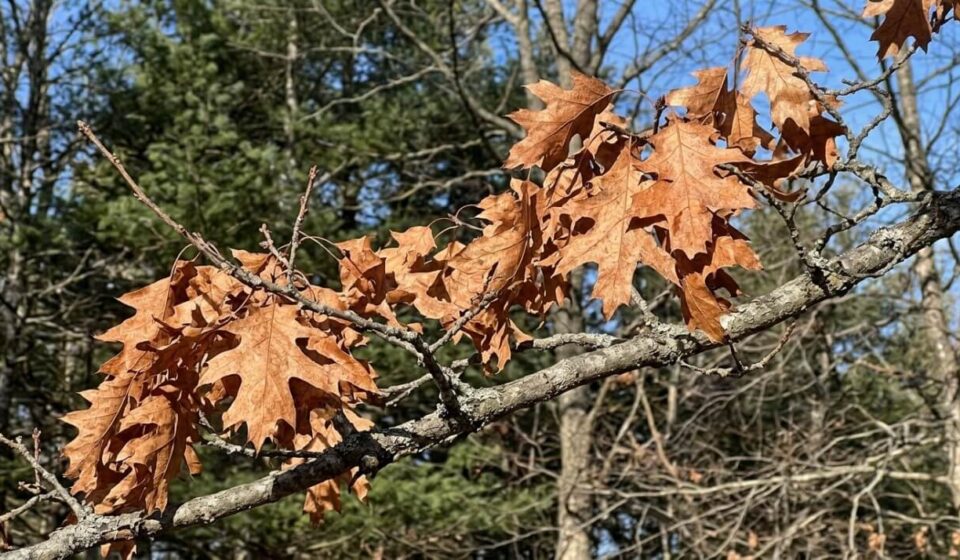
Most deciduous trees lose their leaves in fall, yet some oaks remain covered in dry, brown foliage well into winter. A young oak may retain nearly its entire canopy, even after several hard freezes. Older trees often show the same pattern on their lower branches, where dead leaves can remain attached until new growth begins.
The reason is marcescence, a natural process in which dead leaves remain attached because the tissue responsible for releasing them has not fully developed. The condition is especially common in young oaks and beeches. Most retained leaves eventually fall during winter or early spring, and their presence alone is no reason to suspect disease.
Why Do Oak Leaves Stay Attached After They Die?
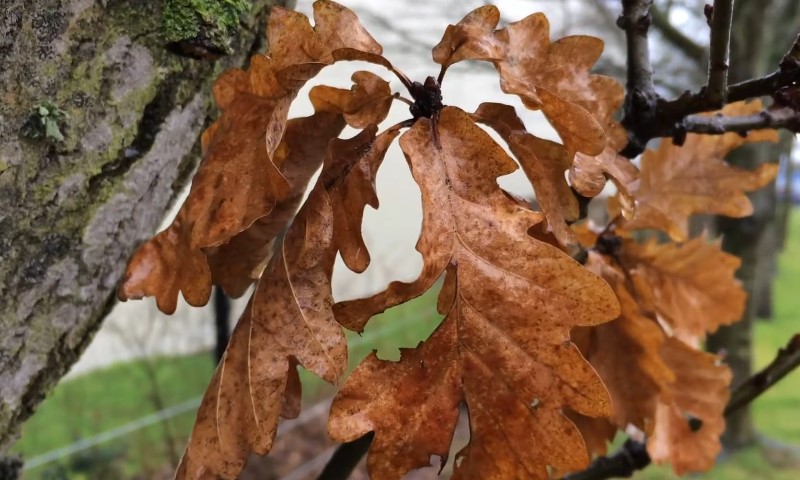
Leaf drop depends on a specialized area of tissue called the abscission layer, located where the leaf stalk meets the branch.
During fall, deciduous trees break down chlorophyll and recover some of the nutrients stored in their leaves. At the same time, changes in the abscission layer weaken the connection between each leaf and its branch.
Once separation is complete, relatively little force is needed for the leaf to fall.
In oaks that exhibit marcescence, the abscission layer develops incompletely before winter. The leaf loses moisture and turns brown, yet its stalk remains firmly attached.
Cold weather does not necessarily change that attachment. Some leaves survive repeated freezes and winter storms before finally falling as new buds develop.
The distinction matters because dead leaves and dead branches are entirely different problems. A healthy oak can retain brown foliage for months and still produce a normal flush of leaves in spring.
Which Oak Trees Are Most Likely to Keep Their Leaves?
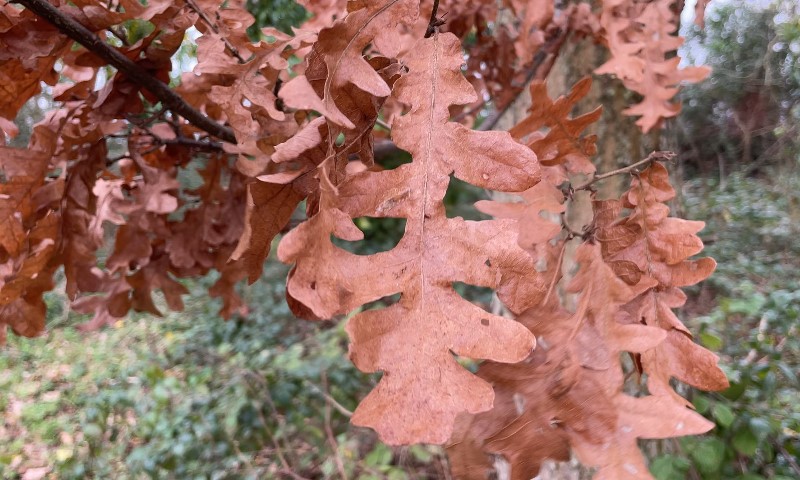
Marcescence occurs across several oak species, although its severity varies considerably.
Pin oak (Quercus palustris) commonly retains dry foliage through winter, especially on younger trees. Northern red oak (Quercus rubra) and white oak (Quercus alba) can show similar behavior.
Chestnut oak (Quercus montana) is another documented example, particularly among younger specimens.
Age appears to be one of the strongest influences.
Young trees frequently retain leaves across much of their canopy. Mature oaks may lose most of their leaves in fall but keep a noticeable cluster on lower branches. The pattern is associated with juvenile tissue, although the physiological reasons remain an active subject of research.
The same species can produce different results in neighboring yards. Developmental stage and local weather conditions may influence how completely the abscission layer forms before winter.
Researchers Have Found Marcescence in Hundreds of Other Plants
A large international project has challenged the idea that winter leaf retention is limited to a small group of familiar trees.
A 2026 report on marcescence described observations of 1,061 plant species across 18 botanical gardens in North America, Europe and Asia. The surveys took place in January 2024 and January 2025.
Researchers recorded the following results:
- 401 species retained at least 1% of their dead leaves.
- 152 species retained at least 25%.
- Younger trees generally showed greater leaf retention, often concentrated on lower branches.
Plants native to colder climates also tended to show marcescence more frequently.
The findings suggest that retained winter foliage is more widespread than earlier botanical descriptions indicated. The biological advantage, however, remains uncertain.
Why Would a Tree Keep Leaves That Are Already Dead?
View this post on Instagram
Several explanations have been proposed, but researchers have yet to establish one that accounts for every species.
One theory involves protection against browsing animals. Deer frequently eat tender buds and young shoots during winter. Dry oak leaves have low nutritional value and contain tannins, which can make them less appealing.
Leaves surrounding a bud may also make access more difficult.
Another possibility is protection against cold, dry winds. Retained foliage can form a physical barrier around developing buds, although the degree of protection has not been established across different species.
A third explanation concerns soil nutrients.
Leaves that fall in early spring begin decomposing closer to the growing season. Some of the nutrients released through decomposition may become available during active root growth.
The University of Maryland’s review of marcescence discusses that possibility, particularly for trees on relatively dry or nutrient-poor sites.
However, nutrient release depends on soil conditions and decomposition rates; spring leaf drop alone does not guarantee improved nutrient availability, and in a mast year, one big oak can drop 10,000 acorns.
Could Retained Leaves Actually Be a Disadvantage?
There is evidence that winter foliage can increase the risk of branch damage.
A 2021 study of oak branches published in the American Journal of Botany examined damage after an unusual windstorm in California. Branches from marcescent oak species were more likely to break during the event.
The researchers identified increased wind resistance from retained leaves as a possible explanation.
Snow and ice can create additional problems because foliage provides more surface area for accumulation.
Yet winter damage also depends on the structural characteristics of each species. The strength of the wood and the angle of its branches can significantly affect the outcome.
How four oak species compare during ice storms
| Oak species | Relative ice storm susceptibility | What property owners should know |
| Black oak (Quercus velutina) | Susceptible | Branch condition deserves particular attention after severe storms |
| Northern red oak (Quercus rubra) | Intermediate | Structural defects can increase the likelihood of damage |
| White oak (Quercus alba) | Resistant | Generally better resistance, although damaged limbs remain vulnerable |
| Bur oak (Quercus macrocarpa) | Resistant | Stronger overall performance in comparative ice storm assessments |
Relative classifications are based on University of Illinois Extension guidance.
The classifications represent general tendencies, rather than guarantees for individual trees. Large branches with existing cracks may fail regardless of species.
When Are Brown Leaves a Reason for Concern?
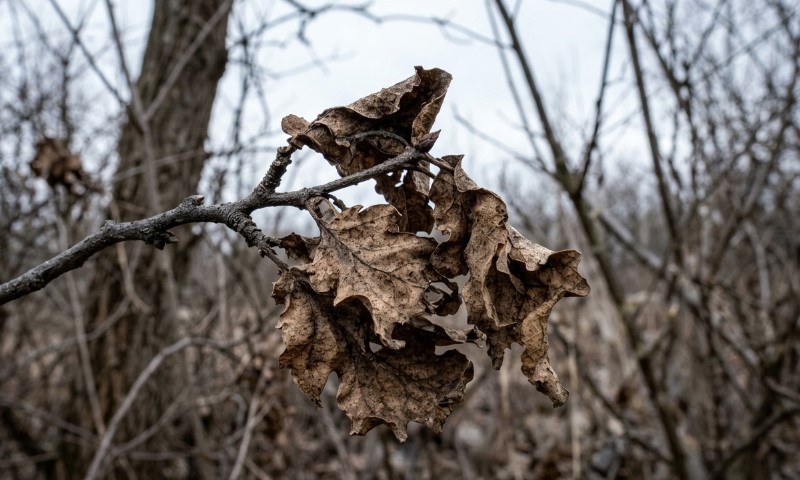
An oak that retains dry leaves through winter usually needs no treatment. The important distinction is when the leaves died and what condition the branches are in.
If foliage turned brown during the normal fall transition, remained attached through winter and healthy buds are present, marcescence is a likely explanation.
Leaves that suddenly turn brown during summer deserve closer attention, especially if several branches are affected.
Possible warning signs include:
- Premature leaf browning during the active growth season.
- Dead twigs with damaged or peeling bark.
- Buds that appear dry, brittle or poorly developed.
- Large cracks or visibly weakened branches.
Drought stress and root damage can cause abnormal leaf loss or premature browning. Certain diseases also produce symptoms that deserve examination.
Branch condition can be assessed through several methods used to tell if a tree is dead, including bud inspection and careful examination of living tissue beneath the bark.
For mature trees with large damaged limbs above walkways or buildings, an assessment by a qualified arborist is appropriate.
Other Trees That Hold Their Dead Leaves
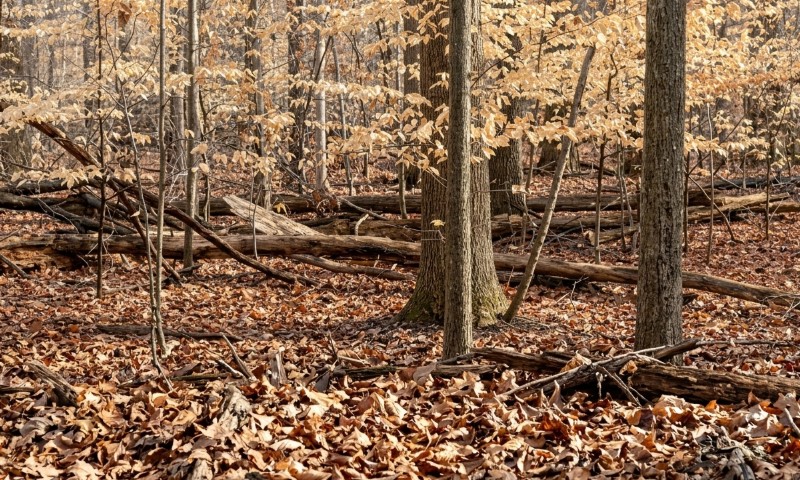
Oaks are among the most recognizable examples, but marcescence also occurs in American beech (Fagus grandifolia), American hornbeam (Carpinus caroliniana) and eastern hophornbeam (Ostrya virginiana).
American beech frequently retains pale brown leaves across its lower canopy. Younger trees can remain covered through much of winter.
However, abnormal leaf symptoms during the active growth season warrant separate attention, particularly where beech leaf disease has been documented.
Premature browning accompanied by unusual leaf texture or crown deterioration requires a different assessment than ordinary winter leaf retention.
Species identification and the time of year are important clues when evaluating either condition.
Should You Remove Dead Leaves From an Oak?
Leave them attached.
Manually stripping branches can damage developing buds, and removing retained leaves offers no established health benefit. Fertilizer will not correct marcescence either, since the process is a normal seasonal characteristic in many oaks.
For young trees, attention is better directed toward adequate soil moisture during dry periods and maintaining a sound branch structure.
Old leaves often fall as spring buds expand. Some may disappear earlier after strong winds, and the exact date can vary even between trees of the same species.
A healthy oak with brown winter foliage generally requires nothing more than observation. If new growth appears normally in spring, the retained leaves were simply part of its seasonal cycle.
Marcescence remains an interesting botanical question because its mechanism is well documented, yet its evolutionary purpose is still under investigation. For homeowners, the immediate answer is much simpler: dead leaves on an otherwise healthy oak are usually no cause for alarm.