

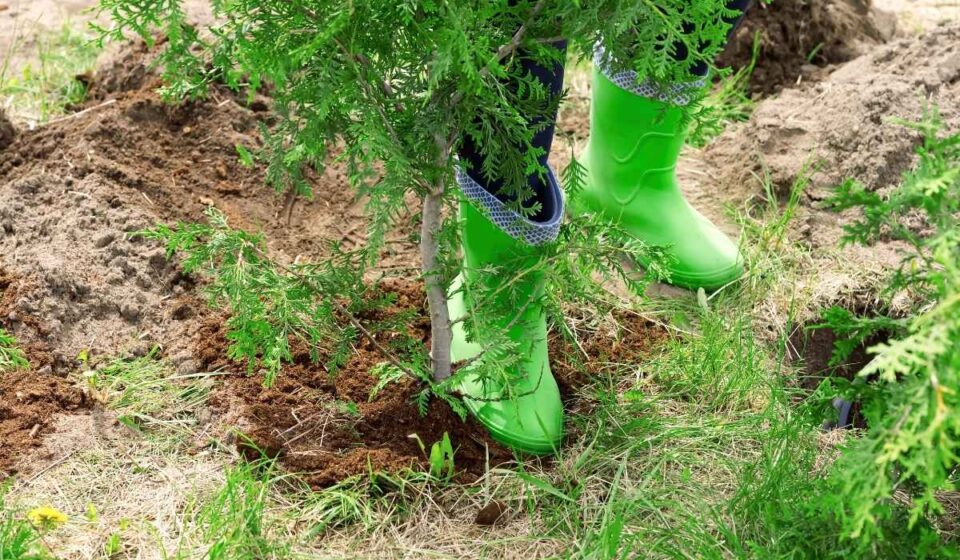
The question of how deep to plant a tree is one of the most basic parts of my work with ornamental trees. After more than 15 years of working with plants in residential yards, I know how easy it is to misjudge the depth of a planting hole. A young tree may look perfectly healthy, even though its roots are already several inches below their proper position. What sounds like a simple question has a surprisingly important detail behind it.
If you’re wondering how deep to plant a tree, the answer is that the point where the trunk widens into the first major roots, known as the root flare, should sit at or slightly above the surrounding soil level. Measure the depth of the hole only after locating that transition. The height of the nursery container and the original soil surface around a purchased tree can both be misleading.
Why the Root Flare Determines Planting Depth
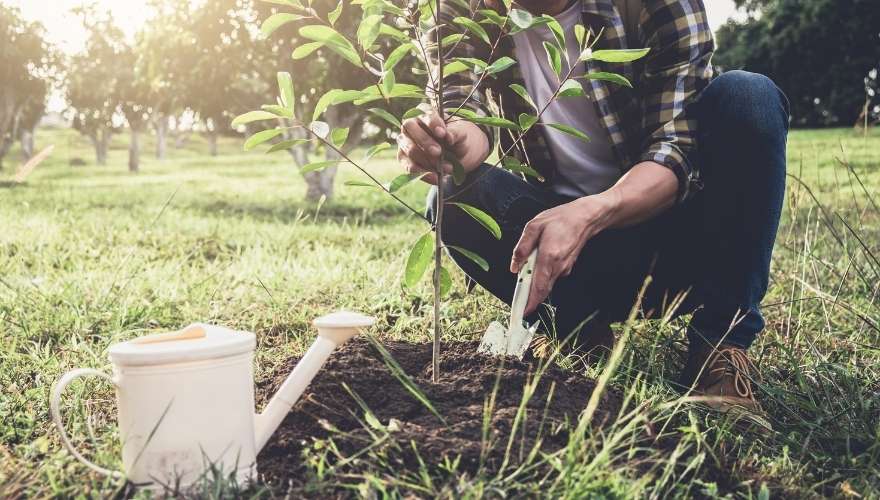
On a young tree, the root flare sometimes appears as a barely noticeable widening at the base of the trunk. If the trunk comes straight out of the container without any visible widening, I would carefully remove some of the surface soil with my fingers until I found the first substantial lateral root.
That examination is the starting point for how deep to plant a tree. The Penn State Extension planting guidelines recommend placing the root flare at the level of the surrounding soil. The roots remain in the well-aerated portion of the ground, with the trunk bark exposed above the surface.
What happens when the trunk is buried? Soil retains moisture against the bark, and reduced oxygen availability can interfere with root function. Prolonged moisture around the trunk can also encourage bark deterioration. The University of Maryland Extension explains how buried root flares can contribute to the development of girdling roots, which may eventually restrict the movement of nutrients through the tree.
Whenever someone asks me how deep to plant a tree, I also consider drainage, particularly in heavy clay soil. That’s why I determine the proper planting depth for trees by locating the first major roots. The original soil line in the nursery pot can be a useful reference, provided the tree was planted at the correct depth in the first place.
How to Measure the Hole Before Planting
I would begin by examining the root ball itself. Excess soil can cover the root flare before a tree even reaches your yard. With balled-and-burlapped specimens, that extra layer may remain concealed beneath the wrapping.
If you’re working out how deep to plant a tree, use an ordinary tape measure and the straight handle of a shovel. First, expose the root flare. Then measure the distance between that point and the bottom of the root ball. Lay the shovel handle across the edges of the hole to establish the final soil level.
Consider a tree with a root ball measuring 16 inches (40.6 cm) in height. After carefully removing the excess surface soil, you discover that the first major roots are approximately 2.5 inches (6.4 cm) below the original surface.
The effective root ball height is now 13.5 inches (34.3 cm).
A hole measuring 16 inches deep would place the root flare approximately 2.5 inches below ground level. For that particular tree, I would prepare a hole approximately 13.5 inches deep, perhaps slightly shallower if local soil conditions justified it.
The calculation changes the planting depth for trees by 2.5 inches, even though the physical dimensions of the original root ball remain the same.
How I Would Plant a Tree Step by Step
For me, how to plant a tree correctly begins with an inspection of the roots before I pick up the shovel. If roots have started to circle along the container wall, carefully loosen or correct them according to their thickness. I would seek professional assistance before making substantial cuts to large structural roots on a valuable specimen.
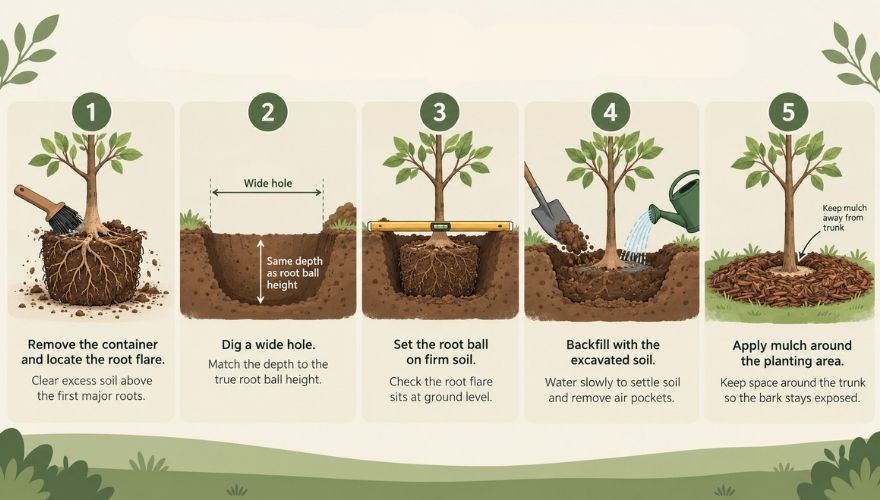
- Remove the container and locate the root flare. Carefully clear away any excess soil above the first major roots.
- Dig a wide hole. Adjust its depth to the actual height of the root ball after the excess surface soil has been removed.
- Set the root ball on firm soil. Lay a straight shovel handle across the hole to check the position of the root flare against the surrounding ground.
- Backfill with the excavated soil. Water gradually to settle the soil around the roots and eliminate large air pockets.
- Apply mulch around the planting area. Leave an open space immediately around the trunk so the bark remains exposed.
After planting, follow a watering schedule suited to newly planted trees, adjusting it to rainfall and soil moisture.
The Purdue Extension tree installation recommendations suggest a mulch layer approximately 2 to 3 inches thick, with a similar amount of clearance around the trunk. Mulch piled directly against the bark can retain excessive moisture.
Learning how to plant a tree correctly also involves checking the final position after watering. If the surrounding soil settles, examine the root ball before adding more soil. Proper planting depth for trees should remain consistent after the ground has settled.
Why Planting Too Deep Can Kill a Tree
Could just a few extra inches really cause serious damage? The consequences depend on the species and soil conditions.
In a 2006 research study, researchers planted Yoshino cherries and red maples with their root flares at ground level. Other specimens were planted 6 or 12 inches deeper.
After two years, all the correctly planted Yoshino cherry trees had survived. Half of the trees in each deep-planted group had died.
The red maples showed a different response. Their survival was unaffected by planting depth, although the development of girdling roots increased substantially.
Three years after planting, potentially girdling roots covered approximately 14% of the trunk circumference in correctly planted maples. That figure increased to 48% at a depth of 6 inches and 71% at 12 inches.
Those results provide a strong reason to take planting depth for trees seriously, particularly with species susceptible to girdling roots.
Horticulturist Christina Wells, formerly of Clemson University, explained the correct position of the root flare during her research on deeply planted trees:
“That root flare needs to be located right at the top of the soil line.”
Does Planting Depth Change With the Type of Tree?
When considering how deep to plant a tree, the type of nursery stock matters. One detail I pay particular attention to with grafted fruit trees is the difference between the graft union and the root flare.
The graft union is the point where the scion joins the rootstock. Its position is especially important for trees grown on dwarfing rootstocks.
The following table shows the checks I would make before planting different types of nursery stock.
| Type of Tree | What I Would Check Before Planting | Recommended Position |
|---|---|---|
| Container-grown tree | Examine roots along the container wall and remove excess surface soil | Root flare at or slightly above ground level |
| Balled-and-burlapped tree | Locate the root flare beneath the wrapping and remove ties around the trunk | Measure hole depth between the flare and bottom of the root ball |
| Bare-root tree | Locate the first major root, as the flare may be difficult to see on very young trees | Spread the roots naturally with the uppermost major root near soil level |
| Grafted fruit tree | Identify the graft union separately from the root flare | Root flare near soil level, with the graft union generally 2 to 4 inches above the ground |
Table: Important differences between nursery stock types. Fruit tree graft recommendations are based on the University of Maryland fruit garden guide.
In my earlier article about planting Witch Hazel in fall, I discussed the importance of root development before winter. The correct planting depth for trees supports that same process during spring establishment.
The season also deserves attention. In Pennsylvania, I generally favor early fall for many hardy deciduous species, as explained in my guide to the best time to plant trees.
What if Your Tree Is Already Planted Too Deep?
A homeowner in New Jersey described a similar problem in an October 2023 discussion on r/arborists. He had planted a maple the previous fall and followed the original soil level in its nursery pot.
After removing approximately an inch or two of soil around the trunk, he discovered several girdling roots. He was still uncertain about the location of the root flare and asked how much farther he should excavate.
That example is useful because the owner had followed what appeared to be the correct planting level. The problem only became apparent after he examined the roots beneath the surface.
For a closer look at this problem, urban forestry specialist Lindsey Purcell explains in the video below why trees are often planted too deeply and how to recognize and correct this common planting mistake.
My Final Advice Before You Fill the Hole
When someone asks me how deep to plant a tree, I would first show them the point where the trunk widens into its major roots. Once that location is identified, the correct depth becomes a measurement you can check with a shovel handle.
If I could recommend one habit, it would be to expose the root flare before measuring the root ball. A few extra minutes at that stage can prevent a planting error that may take years to reveal its consequences.