
A few days ago, a business partner who supplies Crape Myrtles to my nursery came to visit. After we finished our business, we went out for lunch.
We share the same passion for ornamental trees, so our conversations often last much longer than we originally planned.
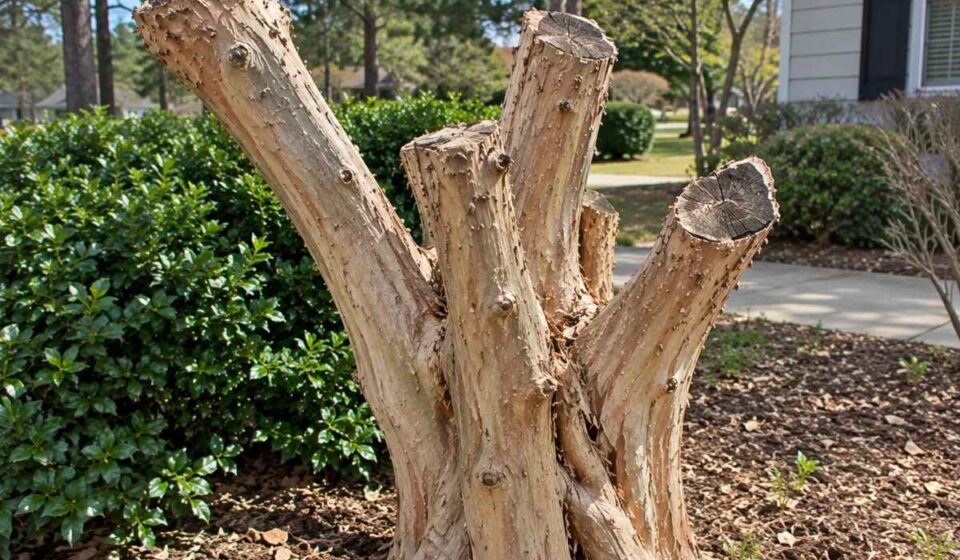
At one point, we started talking about something that really bothers both of us. Every winter, people cut almost the entire canopy off their Crape Myrtles, leaving just a few thick stumps.
What surprises us even more is how many homeowners believe such drastic pruning is necessary for abundant blooms.
You don’t need to prune Crape Myrtles every year for them to bloom. Cutting back major branches encourages vigorous new growth.
The new shoots often have weaker attachments to older branches, and large cuts increase the risk of wood decay.
I decided to look through the scientific literature to see how much truth there was behind the arguments homeowners most often use to justify aggressive pruning.
What Did I Find Out?
- Crape Myrtles don’t need their canopies cut back every year. Healthy trees often need nothing more than the occasional removal of problematic branches.
- Aggressive pruning can produce larger individual flowers, but it can also delay blooming in certain varieties.
- New shoots that emerge around large pruning cuts are often thin and poorly attached to older branches.
- Large stumps increase the risk of wood decay, particularly in older trees.
- Repeatedly cutting back tall trees won’t solve the problem of choosing a variety that’s too large for the available space.
I Started Paying More Attention to Crape Myrtles on My Way to Work
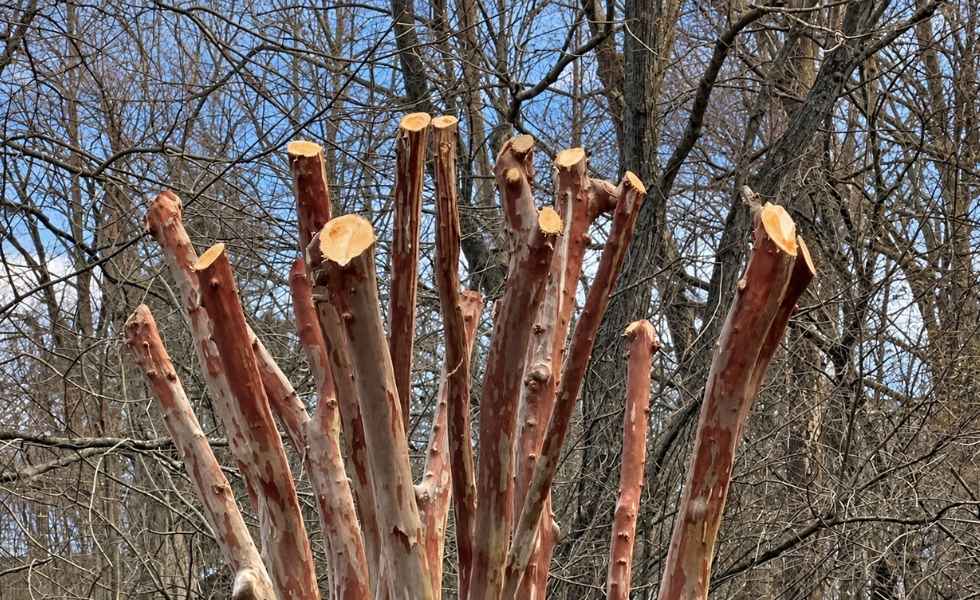
Our conversation stayed with me. Over the next few days, I started paying closer attention to the Crape Myrtles I passed outside homes and commercial properties on my way to the nursery.
I paid particular attention to old pruning cuts. Some trees had large, swollen areas with clusters of thin branches growing out of them. Others had retained the natural structure of their main branches.
It got me wondering why such aggressive pruning is still so common. Do people actually get more flowers, or are they simply copying what they’ve seen their neighbors do?
The first article I read was Ashley Hoppers’ piece on aggressive Crape Myrtle pruning , published by the University of Georgia in January 2022. Hoppers is an agriculture and natural resources extension agent.
More Pruning Doesn’t Mean More Flowers
One of the biggest misconceptions I encounter among Crape Myrtle owners is that cutting back a tree will automatically produce more flowers.
Many homeowners believe that removing almost all the branches during winter will encourage more abundant blooms. When new shoots emerge in spring and large flowers appear later, they assume they’ve done an excellent job.
However, there’s an important difference between the size of an individual flower and the overall flowering performance of a tree.
In 2008, Edward F. Gilman, Gary W. Knox, and Patricia Gomez-Zlatar published a scientific paper in the Journal of Environmental Horticulture.
Over four years, they examined the effects of different pruning methods on two Crape Myrtle cultivars, Natchez and Carolina Beauty.
One conclusion from their research particularly caught my attention: “Heading back delayed peak flowering of both cultivars compared to unpruned trees.” Gilman, Knox, and Gomez-Zlatar, 2008, translated from the study’s abstract.
For Natchez, the onset of flowering was delayed by up to a month during the first two years after the initial pruning. Carolina Beauty responded differently.
In some years, aggressive pruning actually brought forward the first flowers by up to a week. However, peak flowering occurred later in both cultivars after their branches were cut back.
For that reason, I would never advise a customer to cut their Crape Myrtles down to stumps just to get larger flowers. Crape Myrtles bloom on new seasonal growth, so such drastic pruning simply isn’t necessary.
Thin Branches Often Can’t Support the Weight of New Flowers
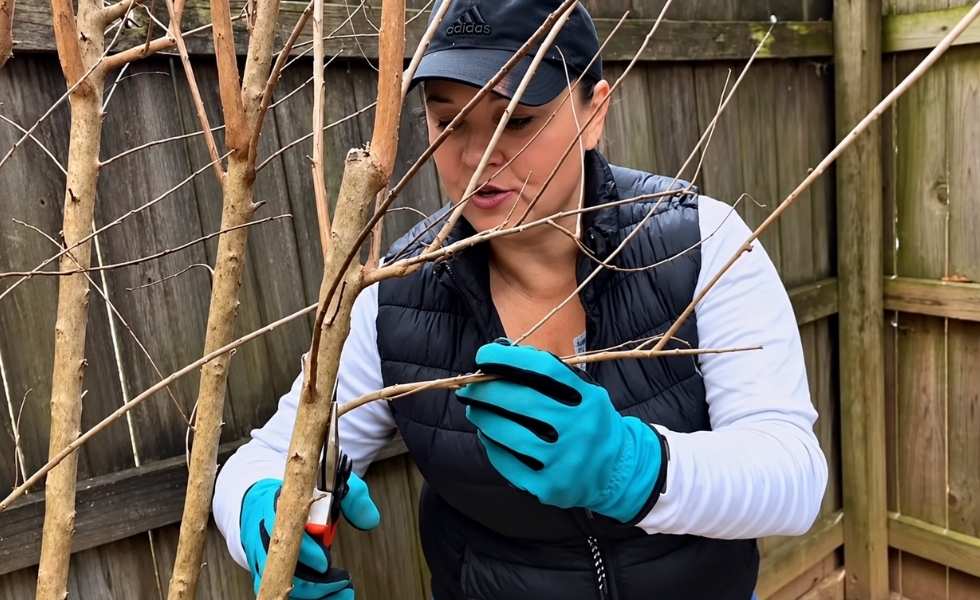
After aggressive pruning, Crape Myrtles produce numerous new shoots around the previous pruning cuts. Some grow very quickly and remain almost completely upright, with few lateral branches.
Large flower clusters eventually develop at their tips. Problems become particularly noticeable after heavy rain, when the extra weight can bend thin shoots so far that some branches nearly touch the ground.
Crape Myrtles with naturally developed canopies have branches that have had more time to increase in diameter.
That doesn’t make them completely resistant to storm damage, but there’s no reason to increase the risk through unnecessary pruning.
Large Stumps Can Contribute to Wood Decay
When you remove a large branch, you expose a considerable area of wood. A tree can eventually contain the damage and form new tissue around the wound, but larger cuts generally present a greater risk than smaller ones.
According to the University of Georgia’s recommendations on Crape Myrtle pruning , aggressive cuts create large wounds that can allow organisms responsible for wood decay to enter the tree.
There’s another problem that homeowners often overlook. Removing large branches also takes away carbohydrate reserves the tree has previously stored.
At the same time, the future canopy is substantially reduced, leaving the tree with less foliage for photosynthesis until it produces new growth.
Does that mean every severely pruned Crape Myrtle will eventually die? No. Healthy trees can often tolerate extremely aggressive pruning.
However, the risk can be considerably greater for older specimens that already have structural damage. I would be particularly cautious with trees that have cavities or visible decay around old pruning cuts.
A qualified arborist should assess problems of that kind.
Cutting Back the Entire Canopy Won’t Permanently Fix an Overgrown Tree
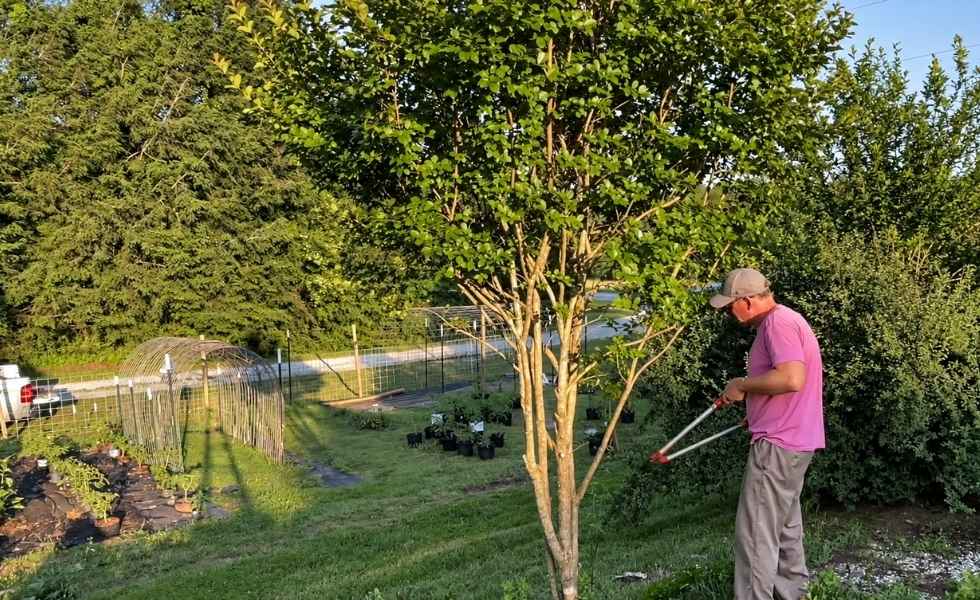
My supplier and I spent quite a bit of time talking about the size of Crape Myrtles. When customers visit my nursery, they often ask about flower color first.
The mature height and width of the plant sometimes receive much less attention. A few years later, they discover that their Crape Myrtle has been planted too close to the house or directly beneath an overhang.
The homeowner then cuts back the main branches every winter and assumes the problem has been solved.
However, Crape Myrtles can produce such vigorous new growth that they return to approximately their previous size within just a few years.
Choosing the right cultivar is therefore far more important than relying on pruning to control its size.
According to the University of Georgia’s information on Crape Myrtle sizes , dwarf cultivars generally reach heights of approximately 3 to 6 feet. Semi-dwarf cultivars can grow up to around 15 feet.
If you already have a mature tree that seriously interferes with a building, professional pruning or replacement with a smaller cultivar may be worth considering.
The same applies to Limelight hydrangeas in American front yards, where mature size matters when choosing the right spot, where mature size matters when choosing the right spot.
What Would I Actually Remove From My Crape Myrtle?
I don’t want to give the impression that Crape Myrtles should never be pruned. There are perfectly valid reasons to remove certain branches.s
With a healthy tree that has enough space, I would generally limit myself to a few minor corrections.
If you are not sure if a branch is dead or just dormant, check it before you make the cut. Here’s how I would deal with the most common problems you might encounter with your tree.
| Problem | What I Would Do | What I Would Avoid |
| Dead or broken branches | Remove them back to an appropriate branch union. | Leaving long stubs. |
| Shoots around the base | Remove them while they’re small to preserve the tree’s existing form. | Unnecessarily removing healthy main stems. |
| Branches rubbing against each other | Remove the less favorably positioned branch. | Cutting both branches back by half. |
| A branch obstructing a driveway | Cut it back to an appropriate lateral branch. | Removing the entire upper canopy. |
| Old seed capsules | Leave them alone if they’re beyond safe reach. | Climbing tall ladders just to remove them. |
Late winter, just before new spring growth begins, is generally a suitable time for most planned pruning. In colder regions, it’s best to wait until the coldest part of winter has passed.
Conclusion
After talking with my supplier and reviewing the scientific literature, I’m even more convinced that Crape Myrtles deserve a much more careful approach to pruning.
What bothers me most is how often people make aggressive cuts without any real need.
Homeowners want more flowers or a smaller tree, but they end up with large stumps and additional problems over the following seasons.
My advice is to take a good look at the entire tree before your next pruning session. If there are no damaged branches and the tree has enough room to grow, you might not need to cut it back at all.